|
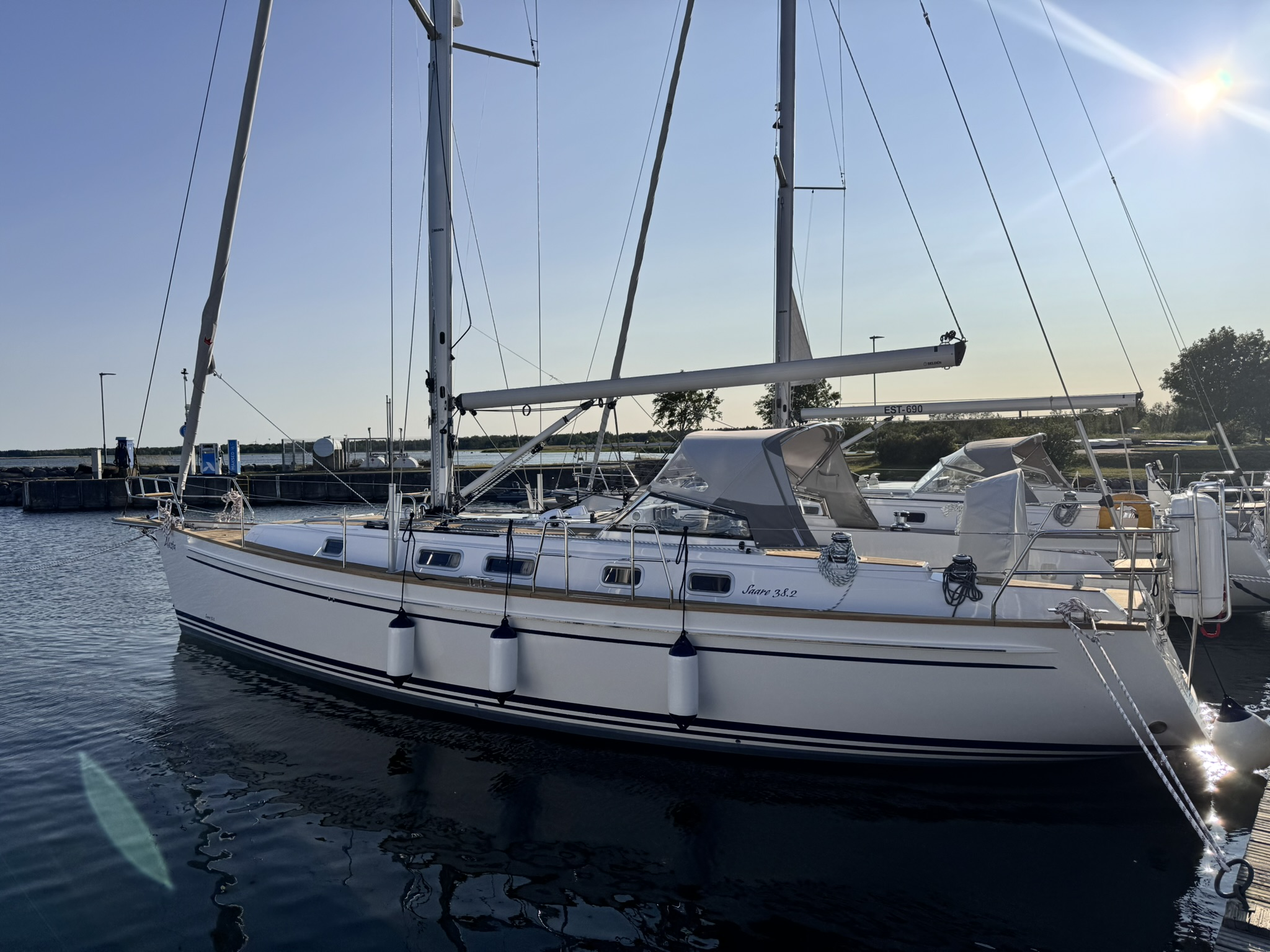
The owners were sailing their Saare 41 near Smögen in the western Swedish archipelago when the yacht experienced a severe grounding at approximately 6 to 6.5 knots under genoa alone. The yacht came to an abrupt and complete stop. They had not merely hit a submerged rock but had collided head-on with a solid underwater boulder.
The crew immediately checked the bilge and the boat for damage, but there were no structural issues or water ingress. Only afterwards did the crew realize that two of them were in severe pain. In total, the crew suffered three broken ribs and several bruised ribs — fortunately, no one was more seriously injured.
After consulting their insurer by phone, it was agreed that the yacht would be inspected by a surveyor in the next harbor.
The surveyor stepped on board with the words: “You don’t assume you’ll be continuing your holiday, do you?” Based on his long experience and the speed at the time of impact, he expected significant damage.
He examined the yacht and tapped all potential damage areas — and then had to revise his initial assessment, saying: “You have an exceptionally well-built boat.” He reported that he could not find any structural damage, and therefore the holiday could safely continue.
The owners carried on with their cruise, albeit more cautiously due to the rib injuries — but where better to recover than on board?
In the autumn, we hauled the yacht out of the water and inspected it together with another surveyor from Pantaenius Insurance.
It became clear how great an advantage our keel construction offers. Not only had the lead keel deformed significantly at the point of impact, absorbing much of the collision energy, but the “stub keel,” which is part of the hull itself, had distributed the remaining energy widely and effectively into the hull — resulting in no GRP damage whatsoever. The surveyor left the boat saying he had “never seen anything like it — no GRP damage at all at this speed.”
It is also worth noting that the keel had no scratches on the underside. Usually, a boat is pushed upward and then slides over the rock, which is a common damage pattern. In such cases, the forces are lower because not all the kinetic energy is absorbed — the boat remains in motion.
In this case, however, the Saare came to an immediate stop, meaning the entire kinetic energy at roughly 6.5 knots was absorbed in a single moment.
The owners are extremely proud and grateful to have such a well-built yacht. They were able not only to continue their holiday without major repairs but also gained the reassurance that with a different boat, the damage — and the resulting situation — would likely have been dramatically worse.
|